
Hyponatremia

By the end of this post you will be able to:
- Localize the cause of hyponatremia using serum osmolality, urine osmolality and urine sodium.
- Initiate first-line treatment for symptomatic and for asymptomatic hyponatremia.
- Apply the correction limit, and recognize and manage overcorrection.
TL;DR
What you need to know before seeing your first patient on your IM rotation with this condition
Estimated read time: 3 minutes

Written by Dr. Caitlyn Vlasschaert. Reviewed by Dr. Jeffrey Kott and Dr. Laiya Carayannopoulos. NephMadness x I@W — Hyponatremia.
Step 0: 3% saline is 100–150 mL over 10–20 minutes, up to three doses — not 50–100 mL every 2–3 minutes. Step 3: volume status is judged at the bedside; the urine sodium cut-off is 30 mmol/L, and a high value also fits renal salt loss. Rate: the goal is 4–8 mmol/L a day (4–6 if high risk), not 6–8; the limit is 10 in 24 hours, or 8 if high risk.
- What it is: A serum sodium below 135 mmol/L, almost always from antidiuretic hormone holding onto free water.
- How it presents: Symptoms track how fast the sodium fell, not how low it is. Moderately severe: nausea without vomiting, confusion, headache. Severe: persistent vomiting, seizures, reduced consciousness. Assess volume status: it decides the fluid.
- Initial tests to order: Serum osmolality (below 275 mOsm/kg: hypotonic), urine osmolality (below 100: ADH off) and urine sodium (cut-off 30 mmol/L), with the first bloods; never delay treating symptoms for them. Add glucose, TSH and a morning cortisol. Look for thiazides, SSRIs, carbamazepine and desmopressin.
- If symptomatic from the sodium — moderately severe or severe: Call your senior now; do not wait for a callback. In a monitored bed: 3% saline 150 mL IV over 20 minutes; check the sodium after each, repeat up to twice, stop once symptoms improve or it is up about 5 mmol/L.
- If stable — treat the cause, cap the rise: Hypovolemic — 0.9% saline 0.5–1 mL/kg/h. Hypervolemic — restrict fluid; treat the cause with your senior. SIADH — restrict to under 1 L/day, then 500 mL/day below urine output. Limit: 10 mmol/L in the first 24 hours — 8 if high risk (sodium ≤105, low potassium, alcohol, malnutrition, liver disease).
- Overcorrection: Past the limit, or a surge of dilute urine near it: stop what is raising it, call your senior; 5% dextrose 10 mL/kg over 1 hour ± desmopressin 2 µg IV.
Listen

Read Around the Case
Based on the US expert panel recommendations (Verbalis et al., 2013), the European clinical practice guideline on hyponatraemia (2014) and the Society for Endocrinology emergency guidance (2022). No Canadian guideline on hyponatremia exists — and these three disagree in places this post flags.
Estimated read time: 23 minutes
The Hyponatremia Sequence
1. Is It Real, and Is It Hypotonic?
Estimated read time: 4 minutes
A low sodium is not always a water problem. Two situations produce a number below 135 mmol/L with no excess water at all, and serum osmolality separates them.
Calculate it while the measured value is pending: osmolality ≈ 2 × [Na] + glucose + urea (all in mmol/L). Urea and alcohol raise it without pulling water, so a high urea or blood alcohol can read 285 or more and still be hypotonic (the European guideline). Then use the two together:
- Hypertonic (≥285 mOsm/kg) — another osmole is pulling water out of cells and diluting the sodium. Check the glucose; hyperglycemia is the usual one, and treating it treats the sodium. Hillier et al. measured the relationship: sodium falls about 2.4 mmol/L per 5.6 mmol/L (100 mg/dL) rise in glucose, more than the widely taught 1.6, and not linearly — 1.6 holds to a glucose near 22 mmol/L, above which 4.0 fits better.
- Isotonic (275–285 mOsm/kg) — pseudohyponatremia. Severe hypertriglyceridemia or a paraprotein displaces enough plasma volume that the analyzer under-reads. The clue is a lipemic sample or known myeloma; the fix is to recheck the sodium on a blood gas, which uses a direct ion-selective electrode and is not fooled.
- Hypotonic (<275 mOsm/kg) — real, and the rest of this post is about it. In practice, a normal glucose with no lipemia and no paraprotein means you are here, and the osmolality confirms rather than surprises.
A measured osmolality well above the calculated one means an unmeasured osmole — ethanol, mannitol, or a toxic alcohol. The last is a different problem, and an urgent one.
Send the osmolality and urine studies with the first bloods. Once saline is running, they no longer reflect the state you are diagnosing.
2. Is ADH On or Off?
Estimated read time: 3 minutes
Urine osmolality answers one question: is antidiuretic hormone working? Someone with excess free water and no ADH should be making maximally dilute urine. If they are not, ADH is on, and something is telling it to be.
- Below 100 mOsm/kg — ADH is off and the kidney is doing its job, so the problem is upstream. Primary polydipsia: a normal kidney excretes at most about 800–1,000 mL an hour, so fast drinking outruns it. Low solute intake: beer potomania and the tea-and-toast diet — excreting water needs solute to carry it, so a diet with almost no protein or salt cannot clear a normal water load. Treatment there is food, not fluid restriction.
- At or above 100 mOsm/kg — ADH is on. That is most ward hyponatremia, and section 3 sorts it.
100 mOsm/kg is a decision line, not a diagnosis — a part-treated patient can sit either side of it.
3. Which Bucket? Volume Status and Urine Sodium
Estimated read time: 5 minutes
With ADH on, the bedside volume assessment leads and the urine sodium supports it — not the other way round.
Thiazides deserve their own line
Thiazides act at the distal tubule and impair free water excretion while leaving urinary concentrating ability intact, so the picture looks euvolemic with a high urine sodium — indistinguishable from SIADH at the bedside, and a common cause on a general medicine ward.
A nationwide cohort of 1,943,345 adults found hospitalization for hyponatremia in 2.19% of thiazide users versus 1.45% (hazard ratio 1.44). Risk rose with age, diabetes and depression.
Stop the thiazide and watch — that is the diagnostic move, not another test. Loops do this less often, because they impair urinary concentration as well.
SIADH — and what has to be excluded first
SIADH is a diagnosis of exclusion: hypotonic hyponatremia, urine osmolality >100 mOsm/kg, urine sodium >30 mmol/L, clinically euvolemic, no recent diuretic use, and no adrenal, thyroid, pituitary or kidney insufficiency. Adrenal insufficiency and hypothyroidism look identical biochemically and are treated differently — check TSH and a morning cortisol before the label goes in the chart.
Five groups of causes, of which the medication list is the one to check first: CNS (stroke, hemorrhage, meningitis) · lung (pneumonia, tuberculosis, positive-pressure ventilation) · malignancy (classically small cell lung cancer) · medications (SSRIs, carbamazepine, antipsychotics, desmopressin, MDMA) · pain and nausea, including post-operatively.
Fluid restriction is first-line, and fails in a substantial minority. In a prospective study of 82 patients, 41% did not respond — sodium up 3 mmol/L or less in 24 hours — and a high urine sodium and high urine osmolality both predicted failure (odds ratio 15.0, 95% CI 2.4–95.8 for urine sodium).
So concentrated urine is a reason to plan the next step early — salt tablets or oral urea, nephrology involved — rather than tightening restriction and waiting. The evidence for urea is real but thin: in a prospective crossover study of 13 patients it matched vaptans over a year of treatment, and it has never been tested against placebo.
4. Treatment, and How Fast to Correct
Estimated read time: 8 minutes
Boluses, not a calculated infusion. SALSA randomized 178 patients (mean sodium 118.2 mmol/L) to bolus or continuous infusion of 3% saline. Overcorrection did not differ — 17.2% versus 24.2%, defined as a rise above 12 mmol/L in 24 hours — but the bolus group needed re-lowering less often, 41.4% versus 57.1%.
Do not set a rate from a deficit formula and walk away. The formulae assume a closed system, and cannot model the patient’s own kidney; the Society for Endocrinology guidance recommends against them. Give a bolus, measure, repeat.
How fast may you correct?
Set the ceiling as you write the first order. Almost every treatment above raises the sodium — hypertonic saline, isotonic saline in hypovolemia, even stopping the thiazide — and they all count toward one 24-hour total.
- The limit. In the European guideline and the Society for Endocrinology guidance it is 10 mmol/L in the first 24 hours, then 8 per 24 hours. In the US panel it is 8 mmol/L in any 24 hours if high risk, otherwise 10–12 in 24 hours or 18 in 48.
- The goal is lower than the limit — 4–8 mmol/L a day in the US panel, 4–6 if high risk, leaving room for overshoot.
- The emergency is the exception, not a contradiction. A seizing patient needs a fast 4–6 mmol/L rise in the first hour — that is part of the daily allowance, not extra to it.
- Write the ceiling down. Count from the lowest value, not from admission: a nadir of 112 means a maximum of 122 at the same hour tomorrow, or 120 if the patient is high risk.
Osmotic demyelination syndrome (ODS)
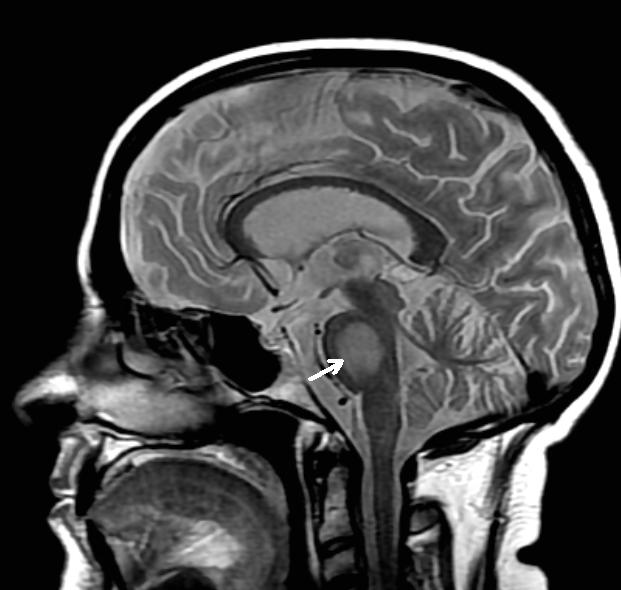
In chronic hyponatremia, brain cells extrude organic osmolytes to avoid swelling. Those take days to replace, so if the sodium rises quickly the adapted cell is left hypertonic to its surroundings, shrinks, and the myelin-maintaining oligodendrocytes are injured. It usually follows correction that was too fast, but not always: 7 of the 12 cases in a Toronto cohort had not been corrected rapidly.
- Where. Classically the base of the pons — the old name central pontine myelinolysis — but also basal ganglia, thalamus and cerebellum. A normal pons does not rule it out.
- When. Biphasic: the patient improves as the sodium normalizes, then deteriorates one to several days later.
- How it presents. Dysarthria and dysphagia, then confusion, quadriparesis, pseudobulbar palsy, and at worst a locked-in state.
- Who is at risk. Sodium 105 mmol/L or lower, hypokalemia, alcohol use disorder, malnutrition, advanced liver disease.
- What happens to them. Across 541 reported patients, 51.9% recovered well and 24.8% died — so a severe presentation is not by itself a reason to withdraw care. No specific treatment exists; prevention is the whole point of the limit.
Two things raise the sodium without anyone ordering it, and both count toward the daily ceiling. Replacing potassium raises the sodium, because potassium entering cells displaces sodium outward — a hidden contributor in exactly the malnourished, hypokalemic patients most at risk of demyelination. And correcting hypovolemia switches ADH off, after which the kidney dumps free water on its own.
If you overcorrect, it is reversible — act on it. Stopping whatever is raising the sodium is a clerk-level action, even at 03:00; then call your senior — the European guideline and the Society for Endocrinology guidance both advise expert input on the 5% dextrose and desmopressin in the table (the US panel allows 2–4 µg).
The limit is contested. On survival, the observational data point one way. Seethapathy (3,274 patients) and Kinoshita (1,024 ICU patients) found slower correction associated with higher mortality; a 2025 meta-analysis of 16 cohorts (11,811 patients) found the same, with no significant rise in ODS; and a 2026 cohort of 13,988 patients linked faster correction to less 90-day death or delayed neurologic injury. But sicker patients are corrected more slowly because they are sicker — confounding these designs cannot remove. In the one randomized trial, actively correcting a sodium below 130 did not change 30-day death or rehospitalization.
On ODS, the data point the other way. The Toronto cohort (22,858 admissions, mostly mild, mean sodium 125) had ODS in 0.05%; 64% were never imaged. In severe hyponatremia the rate is nearer 0.48%, and across 11 cohorts it was 0.73% after rapid correction against 0.10% without. The NephMadness 2024 hyponatremia region argues both sides at length.
What this changes for you: nothing yet. No guideline has moved, so the limit above is what you follow. What it should change is the reflex: both the rate and the patient matter; the risk list tells you whose ceiling to hold hardest.
5. On the Ward
Estimated read time: 3 minutes
Put the monitoring interval in the order, not just the fluid. After hypertonic saline, check the sodium at 6 and 12 hours, then daily until stable (the Society for Endocrinology guidance), and every 4 hours while a 3% infusion runs. Without 3% — 0.9% saline, a stopped thiazide, restriction — check a sodium below 130 every 6 hours until stable (the European guideline; the US panel: every 6–8 hours, particularly below 120). Every 2 hours if the urine output suddenly passes 100 mL/h.
Hand over the ceiling, not just the number. Correction crosses shift changes, so say all three parts out loud: “Sodium 118, up 6 from the nadir, ceiling 122 by 22:00 tonight.” A number on its own leaves the next person to reconstruct the arithmetic.
Count the diluent. Restriction prescribed but not enforced — the patient drinking from the tap, antibiotics arriving in 250 mL bags — is a common reason SIADH appears not to respond.
Hypernatremia, briefly — the mirror image
A sodium above 145 mmol/L is almost always a water deficit in someone who cannot get to water themselves: intubated, living with dementia, post-operative with no oral intake.
- Estimate the deficit as a starting point: total body water × (serum sodium ÷ 140 − 1), taking total body water as 0.6 × weight in kg for younger men, 0.5 for younger women, and 0.5 and 0.45 for older men and women (the European guideline). Give it over 48–72 hours, then recheck the sodium and adjust
- Replace it with water by mouth or nasogastric tube, or IV D5W if the gut cannot be used
- Lower it gradually. A fall of no more than about 0.5 mmol/L an hour is often advised, but no guideline sets a limit, and an ICU cohort of 449 adults found no harm from faster correction
- Think of diabetes insipidus if the urine stays dilute despite a rising serum sodium
Related Podcasts
Test Yourself
Click on your answer to reveal the explanation.
A 74-year-old woman is on day 3 of an admission for community-acquired pneumonia. She is comfortable, her blood pressure is 128/74 mmHg and has been stable, and she is not orthostatic. She has no edema and a normal jugular venous pressure. Morning bloodwork shows a sodium of 126 mmol/L, down from 138 on admission. Serum osmolality is 266 mOsm/kg, urine osmolality 505 mOsm/kg and urine sodium 62 mmol/L. Glucose, TSH and a morning cortisol are normal. She takes sertraline. She has no headache, nausea or confusion.
What is the most appropriate initial management?
A 52-year-old man with alcohol use disorder is admitted with a serum sodium of 104 mmol/L and a witnessed seizure. He receives two 150 mL boluses of 3% saline overnight, the seizures stop, and he is now alert and oriented. His blood pressure is 122/70 mmHg and stable. Twenty hours after presentation his sodium is 117 mmol/L. Urine output over the past four hours has been 900 mL of dilute urine. His potassium was 2.9 mmol/L on admission and has been replaced.
What is the most appropriate next step?
Apply Your Learning
The observational studies in section 4 found slower correction associated with worse survival, not better. No guideline has changed, and you are still expected to cap correction at 10 mmol/L in 24 hours, or 8 in a high-risk patient. Describe how you would explain that tension to a patient’s family — that you are deliberately correcting slowly, using a limit that recent evidence has called into question.
Please do not include patient identifying details — no names, initials, dates, medical record numbers, or any detail that could identify a specific patient or encounter. Write about your reasoning, not about a real person.
Further Reading
- GuidelineClinical practice guideline on diagnosis and treatment of hyponatraemia (ERBP/ESICM/ESE, 2014)
- GuidelineDiagnosis, evaluation, and treatment of hyponatremia: expert panel recommendations (2013)
- Cohort studyOsmotic Demyelination Syndrome in Patients Hospitalized with Hyponatremia (NEJM Evidence, 2023)
- Randomized trialRapid intermittent bolus vs slow continuous infusion of hypertonic saline — the SALSA trial (2021)
- BlogNephMadness 2024: Hyponatremia Region — both sides of the correction-rate argument
Week 3