
Asthma

By the end of this post you will be able to:
- Confirm asthma with objective evidence of variable airflow limitation, and recognize when a diagnosis already written in the chart needs re-testing.
- Assess severity in an acute exacerbation and start treatment, including the features that signal impending respiratory failure.
- Prescribe inhaled corticosteroid–containing maintenance therapy, and explain why reliever-only treatment is no longer acceptable at any severity.
TL;DR
What you need to know before seeing your first patient on your IM rotation with this condition
Estimated read time: 4 minutes

- What it is: Chronic airway inflammation causing variable expiratory airflow limitation. The variability is the diagnosis — obstruction that comes and goes, either spontaneously or with treatment.
- How it presents: Episodic wheeze, cough, chest tightness and breathlessness, worse at night or early morning, provoked by triggers — viral infection, exercise, cold air, allergens, smoke, NSAIDs, beta-blockers, etc.
- Initial tests to order: In an acute exacerbation — oxygen saturation, peak expiratory flow (PEF) as a percentage of personal best, and an arterial blood gas (ABG) if severe or tiring; a venous gas substitutes when arterial sampling is not possible, tracking pH and pCO2 but not PaO2. Chest radiograph only if you suspect a complication. In a new diagnosis — spirometry before and after a bronchodilator.
- If unstable: drowsiness, exhaustion, a silent chest, or a normal or rising pCO2 mean impending respiratory failure. A patient with a severe attack should be hyperventilating; a pCO2 that has climbed back into the normal range is a sign of fatigue, not improvement. Call for critical care help early.
- If stable — the sequence: oxygen to 93–95% → salbutamol 4–8 puffs by MDI with a spacer, every 20 min for the first hour → prednisone 40–50 mg PO within the first hour, 5–7 days, no taper → ipratropium 4–8 puffs q20min if severe → magnesium 2 g IV over 20 min if refractory.
Listen

Read Around the Case
Based on the CTS 2021 Asthma Guideline update, the CTS 2021 focused update on very mild and mild asthma, and the GINA 2025 Strategy Report
Estimated read time: 12 minutes
1. Diagnosis — Proving It Is Asthma
Asthma needs objective confirmation, and the finding you are chasing is variable expiratory airflow limitation. On spirometry that means obstruction that improves after a bronchodilator — a rise in FEV1 of at least 12% and 200 mL. Normal spirometry in a well patient does not exclude asthma; it means you have not yet caught the variability. A methacholine challenge is then the test of choice.
- Spirometry with reversibility — a rise in FEV1 of ≥12% and ≥200 mL after a bronchodilator confirms variable obstruction.
- Normal spirometry does not exclude asthma. It means you have not caught the variability yet, not that it is absent.
- Methacholine challenge when spirometry is unrevealing — a negative challenge in a symptomatic, untreated patient is strong evidence against asthma.
- Peak flow diary showing diurnal variability is a reasonable substitute where challenge testing is unavailable.
- The label is often wrong. In Aaron’s 2017 JAMA study, a third of adults carrying a physician diagnosis of asthma did not have current asthma when systematically re-tested — many after years on inhalers.
- For reading the PFT report itself — the ratio, volumes, DLCO and the flow-volume loop — see the COPD post, which covers it in full.
Confirming the diagnosis

Listen
2. Acute Exacerbation
An exacerbation is a progressive increase in symptoms and airflow obstruction beyond the patient’s usual variation. The treatment is the same in kind whatever the severity and differs in intensity and speed; the CMAJ review of non-ventilatory management (Hodder, 2010) remains the clearest Canadian account.
- Grade severity at the bedside — can they speak in sentences, phrases or single words; accessory muscle use; oxygen saturation; and PEF as a percentage of personal best.
- Do not delay the corticosteroid. It is the drug that changes the trajectory, and belongs in the first hour — not after the bronchodilators have “failed”.
- A normalizing pCO2 is not improvement. A patient in a severe attack should be hyperventilating, so a pCO2 back in the normal range means they are tiring. A chest that has gone quiet is the same warning, not a sign of resolution.
- Discharge is the highest-yield moment of the admission — nobody should leave without a controller and a written action plan, and this is routinely the thinnest part of the note.
3. Maintenance Therapy
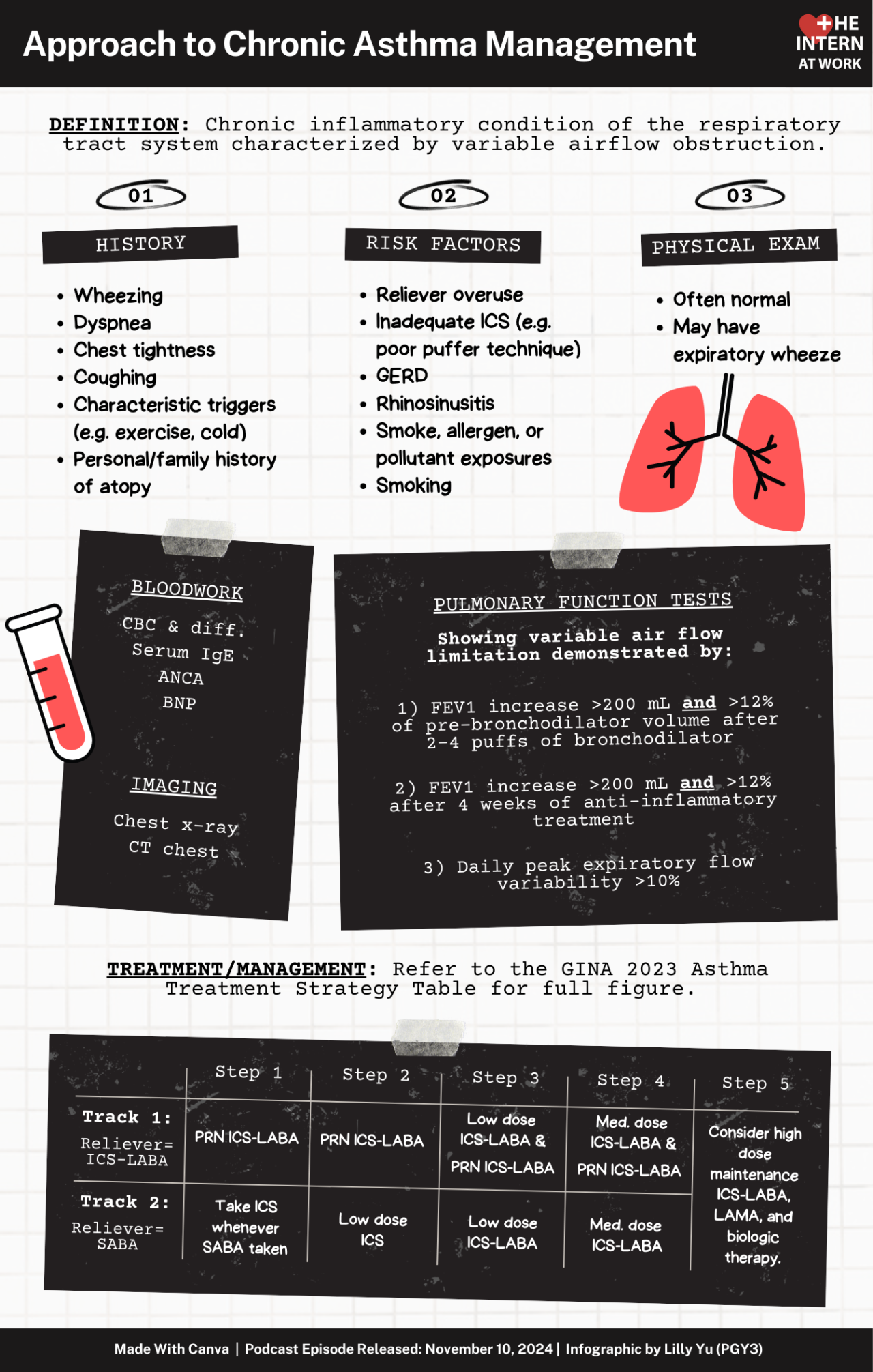
The single most important change in asthma care is that a reliever alone is no longer acceptable treatment at any severity. Every patient with asthma should be on an inhaled corticosteroid (ICS)-containing regimen, because exacerbations and asthma deaths occur in people with apparently mild disease, and reliever-only treatment leaves the underlying inflammation untouched.
- Mild asthma — as-needed ICS-formoterol, the anti-inflammatory reliever (AIR) approach, endorsed by the CTS 2021 mild-asthma update and GINA on the strength of SYGMA 1 and SYGMA 2.
- Needs maintenance — MART: the same ICS-formoterol inhaler as both controller and reliever. Simpler than two devices with opposite inhalation techniques.
- Never a LABA without an ICS. Long-acting beta-agonist monotherapy in asthma is associated with increased asthma-related death.
- Reassess before escalating — adherence, technique and trigger exposure explain more uncontrolled asthma than an inadequate drug does.
Listen
4. Difficult and Severe Asthma
Before calling asthma severe, rule out the far commoner problem of asthma that is difficult for other reasons.
- Adherence — refill records beat self-report.
- Technique — watch them use the device rather than asking whether they know how.
- Comorbidities — allergic rhinitis, chronic rhinosinusitis with nasal polyps, gastroesophageal reflux, obesity, obstructive sleep apnea (OSA), etc.
- Inducible laryngeal obstruction — frequently mistaken for refractory asthma, and it does not respond to escalating inhalers.
- Ongoing exposure at home or at work matters as much as any drug.
Then phenotype. The CTS severe asthma statement identifies blood or sputum eosinophils, FeNO and total IgE as the biomarkers predicting response to biologic therapy; total IgE also determines anti-IgE (omalizumab) candidacy and dosing. Anti-IgE, anti-IL5 and anti-IL4R agents are all specialist-initiated.
Two syndromes worth recognizing. The same statement notes that eosinophilic granulomatosis with polyangiitis (EGPA) and allergic bronchopulmonary aspergillosis (ABPA) occur in a minority of people with severe asthma, and that recognizing them matters because they change treatment. Neither is screened for routinely: send an ANCA when marked eosinophilia comes with systemic features — neuropathy, rash, sinusitis, infiltrates — and think ABPA when IgE is very high with proximal bronchiectasis. Order these when severe or atypical asthma raises the question, not in a routine workup.
Listen
5. Triggers, Action Plans and Follow-up
Self-management education with a written action plan is one of the four core components of asthma care in the CTS 2021 guideline.
- Written action plan — usual treatment, what to do when symptoms worsen, and when to seek help. Asthma Canada has a ready-made patient action plan worth handing out.
- Quadruple, do not double. Doubling the ICS does not work; quadrupling it at the first sign of deterioration reduces severe exacerbations, and is a concrete instruction a patient can follow.
- Triggers — viral infection, allergens, exercise, cold air, smoke, NSAIDs, non-selective beta-blockers, etc. Address them rather than listing them.
- Ask about work. Occupational asthma is easy to miss and the exposure is modifiable — symptoms that improve away from work and on holiday are the clue.
- Vaccination, smoking and vaping, air quality — influenza and COVID-19 vaccination, cessation support, and a plan for wildfire smoke season.
- Follow up within a few weeks of an exacerbation, when the risk of another is highest and adherence is most negotiable.
Listen
Count the reliever inhalers. The CTS 2021 guideline defines SABA overuse as more than two reliever inhalers in a year — each holds about 200 doses — and lists it as a risk factor both for severe exacerbation and for asthma-related death. Needing a reliever more than twice a week should prompt the same reassessment. It is the rare asthma risk factor you can verify without the patient: it is sitting in the pharmacy refill record. A patient who tells you their blue inhaler works beautifully and goes through one every two months is telling you their asthma is dangerously uncontrolled.
Trial Files
Test Yourself
Click on your answer to reveal the explanation.
A 24-year-old woman presents to the emergency department with two days of worsening asthma. She is sitting forward and speaking in single words. Respiratory rate 32 breaths/min, heart rate 124 beats/min, blood pressure 128/76 mmHg and stable, SpO2 91% on room air. Her chest is quiet with poor air entry throughout. An arterial blood gas shows pH 7.36, pCO2 41 mmHg (normal 35–45) and pO2 62 mmHg.
Which finding is most concerning?
A 29-year-old man with asthma uses his salbutamol inhaler four to five times a week for symptoms, and wakes with symptoms about twice a month. He takes no controller. He had one course of prednisone in the past year. Blood pressure is 118/72 mmHg. Spirometry has confirmed reversible obstruction, and his inhaler technique is checked and correct.
What is the most appropriate next step in his management?
Reflect
You are admitting a 34-year-old woman for her third “asthma exacerbation” this year. Each previous admission was treated with salbutamol and prednisone, and each time she improved. Her chart records asthma diagnosed at age 19. Searching her record, you cannot find spirometry — ever. What would make you question the label, and what would you actually do on this admission?
Please do not include patient identifying details — no names, initials, dates, medical record numbers, or any detail that could identify a specific patient or encounter. Write about your reasoning, not about a real person.
Further Reading
- Canadian Guideline2021 CTS Guideline Update: Diagnosis and Management of Asthma
- Canadian Guideline2021 CTS Focused Update: Very Mild and Mild Asthma
- International GuidelineGINA 2025 Strategy Report
- Landmark StudyReevaluation of Diagnosis in Adults With Physician-Diagnosed Asthma
- Canadian ReviewManagement of Acute Asthma in Adults in the Emergency Department — Hodder et al, CMAJ 2010;182(2):E55–67
Week 2